
The History of Huntington Lake
Read more about the history of Huntington Lake in California.
The Western Mono People
Upon first glance, you would never guess that beautiful Huntington Lake is man-made. Before the lake was created, it was a basin used by the Western Mono people during the summer and fall seasons.
The original stream bed that ran through the basin provided a plethora of natural resources for the Native Americans in the area. Deer and fish were plenty, as were local berries and nuts such as strawberries, gooseberries, elderberries, pine nuts, and acorns.
The Big Creek Hydroelectric Project
In 1886, John Eastwood saw the plentiful water source and noticed the 4,500-foot drop in elevation from the basin to the San Joaquin Valley floor. He hoped to harness this natural element as a source of hydropower for Southern California.
It wasn’t until 1902 that Eastwood, working for Pacific Light and Power Company, selected Big Creek as the site for the hydroelectric project. Construction began in 1909 and continued until 1929 with a total of six dams, eight tunnels, three lakes (Huntington, Florence, and Shaver), five powerhouses, and 248 miles of steel tower transmission lines.
At the time, the “Big Creek Hydroelectric Project” was considered the greatest engineering achievement, second only to the Panama Canal.
The Creation of Huntington Lake
Three of the dams built during the Big Creek project were used to create the new man-made lake, with Huntington Lake itself being completed in 1913. In 1919, the height of the three dams was raised, increasing the lake’s storage capacity.
Today, Southern California Edison (SCE) operates the project’s dams and controls the water levels of the lakes. SCE lowers the water level of Huntington Lake in the fall after the peak recreation season to prepare for snowmelt and spring rains.
Huntington Lake and World War II
Huntington Lake was made famous when a World War II B-24 Liberator with six men crashed into the lake in December of 1943. Due to loss of hydraulic power, the pilot needed to make an emergency landing during a severe snowstorm and mistook the frozen lake for a mountain meadow. Two of the six men survived. Remains of the plane are still at the bottom of the lake.
Huntington Lake Today
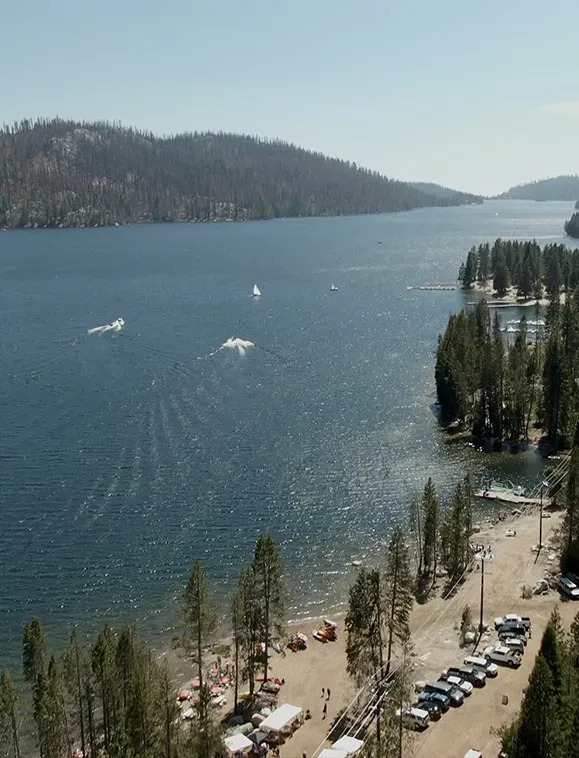
Huntington Lake continues to be a beautiful destination full of opportunities for recreation and relaxation. Whether you prefer rustic camping or a cottage near the lake, Huntington has both.
California Land Management operates seven public campgrounds, mainly around the north shore, offering tent and RV camping with drinking water, toilets, and swimming facilities. Resorts and private condo rentals offer alternatives for visitors who prefer less rustic accommodations.
If you are looking for cool summer retreats during those hot summer months, come up to Huntington Lake where there is always something to do!
Huntington Lake Statistics
Lake Type: Artificial Reservoir
Dammed Completion Year: 1913
Water Level Control: Southern California Edison
Company Surface Area: 1,435 acres
Shoreline Length: 14 miles
Normal Elevation (above sea level): 6,950 ft
Maximum Depth: 128 feet
Water Volume: 89,166 acre-feet
Catchment/Drainage Area: 81 sq.miles